



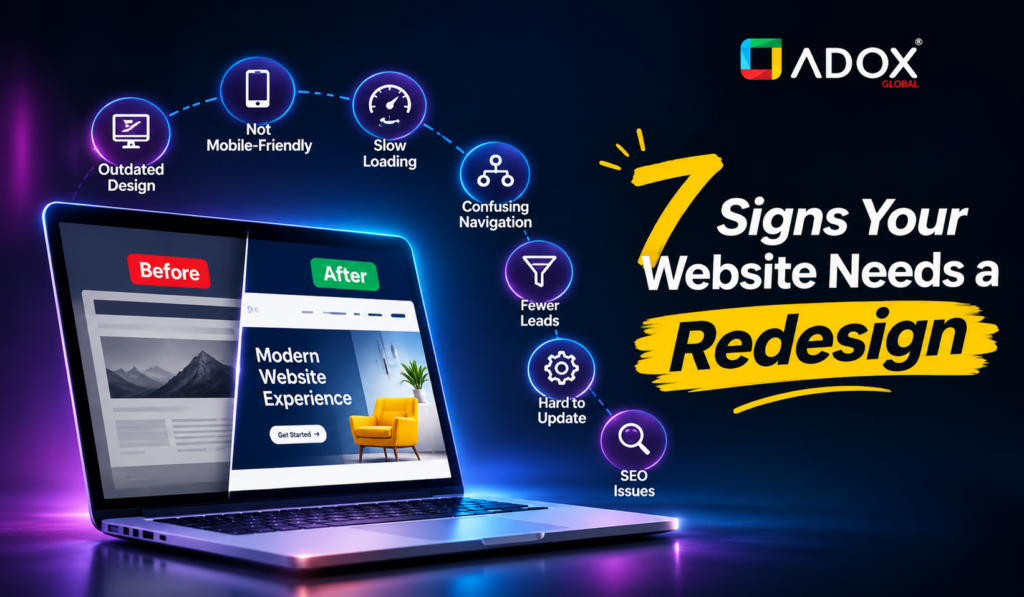
7 Signs Your Website Needs a Redesign
A customer hears about your business from a friend. They search for your company, visit your website and leave within ten seconds.
You’ll never know they visited or why they left. But this happens every day to businesses whose websites haven’t kept up with changing customer expectations.
Today, people expect websites to load quickly, work smoothly on mobile devices and make it easy to find information. If your website fails to deliver these basic experiences, it could be costing your business valuable enquiries and potential customers.
At ADOX, we understand how important a well-designed website is for business growth. A website should do more than display information. It should create a positive first impression, build trust and guide visitors towards taking action.
Here are seven common signs that your website needs a redesign and how improving it can benefit your business.
1. Your Website Design Looks Outdated
First impressions matter. Customers often form an opinion about a business based on how its website looks and feels.
If your homepage still uses outdated stock photos, old-fashioned fonts, inconsistent colours or a layout that no longer represents your brand, visitors may question your business’s credibility.
An outdated website doesn’t necessarily mean you need to follow every new design trend. Instead, your website should reflect your current brand identity and provide a professional experience.
Your logo, colours, fonts, images and overall presentation should be consistent across your website, social media platforms and other marketing materials.
Good web design is about more than appearance. It should make information easy to understand and help visitors explore your services without confusion.
A modern website design also helps communicate your business values, showcase your services and create a stronger connection with potential customers.
2. Your Website Is Not Mobile-Friendly
Here’s a simple test. Open your website on your smartphone and try browsing through its main pages.
Do you have to zoom in to read the text? Are the buttons difficult to tap? Does the page move sideways when you scroll? If so, your visitors may be experiencing the same problems.
A website that doesn’t work properly on mobile devices can quickly lose potential customers. Many people use smartphones to search for services, compare businesses and make enquiries. A poor mobile experience can encourage visitors to leave and explore other options.
A mobile-friendly website automatically adjusts its layout to different screen sizes. Text remains readable, buttons are easy to tap and navigation works smoothly.
Mobile responsiveness is also important for SEO. Google primarily uses the mobile version of a website for indexing and ranking through its mobile-first indexing approach. You can learn more through Google’s mobile-first indexing guidance.
A responsive website design helps provide a consistent browsing experience across smartphones, tablets and desktop devices while supporting your website’s search visibility.
3. Your Website Loads Slowly
Nobody likes waiting for a website to load. When visitors have to wait several seconds to access a page, many simply leave and look for another website.
Website loading speed plays an important role in user experience. A slow website can affect engagement, increase abandonment and reduce the chances of visitors completing an enquiry or purchase.
Some common reasons behind slow website performance include:
- Large images that haven’t been properly compressed.
- Outdated or unnecessary plugins.
- Too many scripts running in the background.
- Poorly optimised website code.
- Inefficient hosting and server performance.
A website redesign provides an opportunity to review these issues and improve overall performance.
You can check your website’s current performance using Google PageSpeed Insights. It provides performance scores and recommendations for improving loading speed and Core Web Vitals.
Pay particular attention to Largest Contentful Paint (LCP), Interaction to Next Paint (INP) and Cumulative Layout Shift (CLS). These Core Web Vitals help evaluate loading performance, responsiveness and visual stability.
A faster website makes browsing more convenient and helps visitors access important information without unnecessary delays.
4. Visitors Struggle to Navigate Your Website
Imagine entering a shop where there are no signs, no clear sections and no easy way to find the products you need. Most customers wouldn’t spend much time trying to figure things out.
A confusing website creates a similar experience. Too many menu options, unclear page names and poorly organised information can make it difficult for visitors to find what they are looking for.
Good website navigation should feel simple and natural. Visitors should be able to understand your main services, explore important pages and find contact information without unnecessary clicks.
Some important elements of effective website navigation include:
- Clear and organised menu categories.
- Simple and meaningful page names.
- Easy access to important service pages.
- Visible contact details and enquiry options.
- Consistent navigation across different pages.
When developing a website, understanding how visitors move from their first interaction to making an enquiry is an important part of the design process.
A well-organised website structure also helps search engines discover and understand the relationship between your website pages. This makes navigation beneficial for both users and SEO.
5. Your Website Is Not Generating Enough Leads
This is one of the most frustrating situations for business owners. People are visiting your website, but the phone isn’t ringing and the enquiry form remains empty.
Getting website traffic is important, but attracting visitors alone doesn’t guarantee business enquiries.
Sometimes, the problem is related to how your website encourages visitors to take the next step.
Here are some common reasons:
- No clear call-to-action buttons.
- Enquiry forms that request too much information.
- Contact details hidden at the bottom of the page.
- Unclear service descriptions.
- Lack of trust signals, testimonials or customer reviews.
A website redesign can help address these issues by making important information and contact options easier to access.
For example, adding clear buttons such as “Get a Free Quote”, “Book a Consultation” or “Contact Us” can guide visitors towards the next step.
You can also improve conversion opportunities by displaying customer testimonials, project examples, service benefits and relevant business information. These elements help visitors understand your value before making an enquiry.
Every important page should have a clear purpose and guide visitors towards a relevant action.
6. Your Website Is Difficult to Update
Your business changes over time. You may introduce new services, update prices, publish blog posts, add team members or launch seasonal offers.
Your website should make these updates simple.
However, if every small change requires contacting a developer or working through a complicated admin panel, keeping your website updated can become difficult.
As a result, visitors may find outdated service information, expired offers, old contact details and irrelevant content.
A website redesign provides an opportunity to move to a modern content management system that makes website management easier.
With a user-friendly content management system, your team can update text, replace images, publish blogs and manage website content without depending on developers for every small change.
A flexible website structure also makes it easier to introduce new services, create additional landing pages and expand your website as your business grows.
A well-planned website should support your daily business activities rather than create additional work.
7. Your Website Is Not Supporting Your SEO Goals
Your website should help potential customers discover your business through Google. If your important pages aren’t receiving organic traffic or your website struggles to appear for relevant searches, there may be technical or structural issues that need attention.
Common website issues that can affect SEO include:
- Poor website architecture and internal linking.
- Missing or improperly structured headings.
- Broken links and unnecessary redirects.
- Slow-loading pages.
- Duplicate or poorly optimised content.
- Missing or incorrect metadata.
- Poor mobile usability.
A website redesign provides an opportunity to review these elements and establish a stronger SEO foundation.
A properly structured website makes it easier for search engines to crawl, understand and discover relevant pages. Relevant content, clear headings, internal links and good technical performance all contribute to a better website experience.
You can refer to Google’s Search Essentials to understand the basic requirements for making your website accessible to Google Search.
However, a new website design alone won’t guarantee higher Google rankings. SEO also depends on content quality, search intent, relevance, technical optimisation and ongoing improvements.
An SEO-friendly website redesign should consider existing organic traffic, indexed pages, important URLs, backlinks and current keyword rankings before making major changes.
Preserving valuable URLs wherever possible and implementing appropriate 301 redirects when URLs change can help protect existing search visibility during a redesign.
What Can a Website Redesign Improve?
A properly planned website redesign can improve several aspects of your online presence. It helps create a more professional appearance, improves mobile usability, supports faster loading speeds and makes it easier for visitors to explore your services.
Here are some important benefits:
- Improved user experience: Makes it easier for visitors to find information and navigate your website.
- Better mobile responsiveness: Provides a consistent experience across different devices.
- Improved website performance: Addresses loading issues and unnecessary technical elements.
- Stronger brand presentation: Creates a consistent and professional online identity.
- Better lead generation opportunities: Makes contact options and calls to action more accessible.
- SEO-friendly website structure: Supports crawling, indexing and content discovery.
- Easier website management: Allows your team to update and maintain website content more efficiently.
The important part is planning the redesign properly. It should be based on your current website performance, customer expectations and business objectives rather than personal design preferences alone.
Frequently Asked Questions About Website Redesign
1. How often should a business redesign its website?
There is no fixed timeline for redesigning a website. It depends on your website’s performance, technology, business requirements and customer expectations. Reviewing your website regularly can help identify when major improvements are needed.
2. How much does a website redesign cost?
Website redesign costs depend on factors such as the number of pages, design requirements, functionality, integrations and development complexity. A detailed project assessment can help determine the actual cost.
3. How long does a website redesign take?
The timeline depends on the website’s size, design complexity, content requirements and development work. Smaller websites may take less time, while larger business websites and e-commerce platforms require additional planning and development.
4. Will redesigning a website affect existing Google rankings?
A website redesign can affect search rankings if important URLs, content, internal links or technical SEO elements are changed without proper planning. Preserving valuable content, maintaining URLs where possible and implementing relevant redirects can help minimise potential SEO disruptions.
5. What should businesses consider before redesigning a website?
Businesses should review their current website performance, user experience, mobile responsiveness, SEO health, content structure and conversion goals before starting a redesign. This helps ensure that the new website addresses existing problems.
Conclusion: Is It Time to Redesign Your Website?
An outdated design, poor mobile experience, slow loading speed, confusing navigation, fewer enquiries, difficult content management and SEO problems are all signs that your website may need attention.
If two or three of these issues sound familiar, it may be time to evaluate your existing website and identify areas that need improvement.
Remember, a website is more than an online presence. It represents your business, communicates your services and helps potential customers decide if they want to work with you.
At ADOX, we help businesses build modern, responsive and user-friendly websites that support their digital goals.
Looking to improve your existing website or build a completely new one? Explore ADOX website design services and get in touch with our team to discuss your requirements.