



Search Console’s New Generative AI Reports: What Every SEO Should Know
For nearly two years, SEOs have been stuck guessing. Traffic dips, rankings hold steady, and yet nobody could say for certain whether a page was actually appearing inside AI Overviews or AI Mode. That guessing game officially ended on June 3, 2026, when Google rolled out dedicated Search Generative AI performance reports inside Google Search Console. For the first time, site owners have an official, native way to see how their pages show up inside Google’s AI-powered answers — not a third-party estimate, not a traffic-drop inference, but real data straight from Google itself.
If you run a website, manage content for clients, or work with an SEO services in Kochi provider, this update deserves your full attention. It changes how visibility should be measured going forward, and it opens up a genuinely new layer of optimization that didn’t exist before.
What Is the Search Console Generative AI Report?
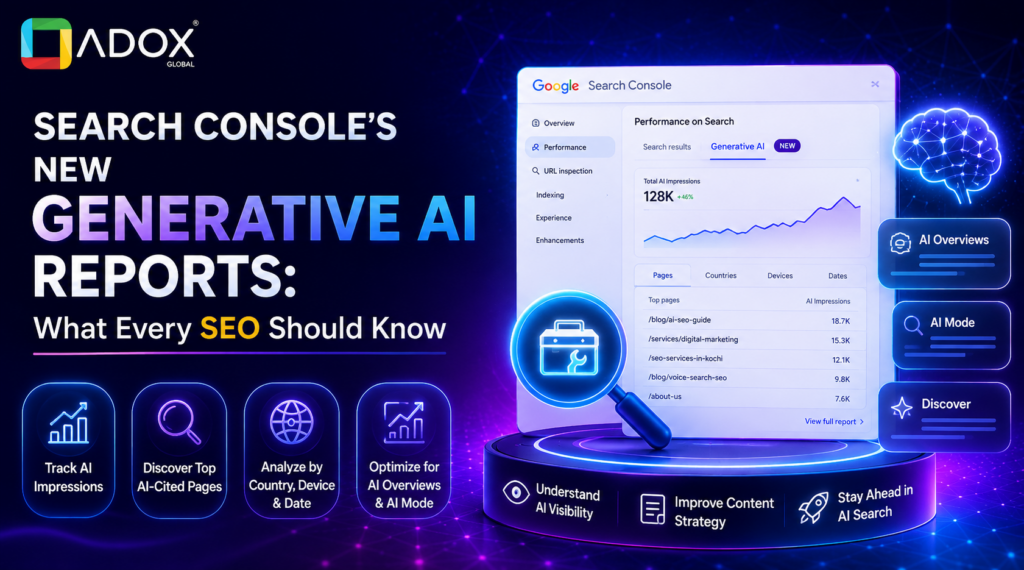
The new Generative AI report is a dedicated section within the Performance area of Google Search Console. It shows how often your website appears in Google’s AI-powered search experiences.
These include:
- AI Overviews
- AI Mode
- AI-generated summaries in Discover
Instead of focusing only on traditional search rankings, the report measures how often your content is shown inside Google’s AI responses. As more users receive direct answers instead of clicking through search results, this information becomes increasingly important.
What Exactly Launched
Google’s Search Central team, led by Search Ecosystem Engineering Manager Hillel Maoz and Product Manager Lead Moshe Samet, introduced a new “Generative AI” tab inside the Performance section of Search Console. It sits alongside the familiar Search results view, and it appears in two separate places: one for standard Search (covering AI Overviews and AI Mode) and one for Discover, where Google’s AI-generated summaries also now appear.
The report tracks an impression every time a URL from your site shows up inside one of these AI surfaces. Underneath the total impression count and its trend line, four tabs break the data down further: pages, countries, devices, and dates (viewable hourly through monthly). The pages tab is arguably the most useful piece of the whole report, since it tells you exactly which URLs Google’s AI systems already trust enough to cite. That’s a direct roadmap for what kind of content to build more of.
It’s worth noting this isn’t new data being collected for the first time — Google has confirmed that AI impressions were always folded into your overall performance totals. What’s new is the dedicated, separated view that isolates them so you can actually analyze this layer of visibility on its own.
What Data Does It Show?
The first version of the report keeps things simple.
At the moment, it only includes impressions, meaning the number of times your content appears in Google’s AI features.
The data can be filtered by:
- Page
- Country
- Device
- Date
Currently, it does not include:
- Clicks
- Click-through rate (CTR)
- Query-level data
- Conversion information
Even with their limitations, these impressions still give useful information on which pages Google already considers trustworthy enough to weave into answers that AI outputs.
What’s Still Missing
The report is useful, but it isn’t complete. Right now, it shows impressions only. There’s no click data, no CTR, and no query-level detail yet. That means you can see that your content is being surfaced inside an AI answer, but you can’t yet tell how much of that visibility is translating into actual visits. For any business tracking ROI — including brands working with a full-service digital marketing agency — this is an important caveat. Rising AI impressions with a flat Analytics graph isn’t a red flag; it may simply mean you’re winning visibility that hasn’t been fully measurable until now.
Google has also introduced a toggle that lets site owners choose whether their content appears in AI Overviews, AI Mode, and Discover’s AI features at all. That’s a meaningful control to have, especially for brands weighing whether AI-driven answer boxes help or cannibalize their organic traffic.
Rollout and Availability
The rollout began with a smaller group of site owners, with early testing concentrated in the United Kingdom before a broader global release. If you log into Search Console and don’t see “Generative AI” listed under Performance yet, you’re not alone — Google has said it wants to gather feedback before expanding access more widely. It’s worth checking back regularly, since this is expected to reach most Search Console properties in the coming months.
Why This Matters for Local and Regional SEO
For businesses that rely on regional visibility, this report is a big deal. Local search behavior has shifted heavily toward AI-mediated answers over the past year, and knowing which of your pages are actually being pulled into those answers changes how you prioritize content. A business working with an experienced SEO services in Kochi team can now use this data to see, page by page, what content Google’s AI already considers authoritative — and build a content calendar around expanding that trust rather than guessing at it.
This is also where a capable digital marketing agency adds real value beyond basic reporting. Reading impression trends correctly, understanding which pages are earning AI citations, and adjusting on-page structure, schema, and topical depth to earn more of them requires ongoing interpretation, not a one-time audit.
How to Put the Report to Work
A few practical steps make the new report immediately useful:
- Check the pages tab weekly and note which URLs are gaining or losing AI impressions over time.
- Cross-reference AI impression trends with your regular Analytics data to spot pages that may be winning visibility without yet showing traffic gains.
- Study your top-cited pages for shared patterns — clear definitions, structured headings, strong entity signals — and apply those patterns to underperforming content.
- Decide deliberately whether the new opt-out toggle makes sense for any part of your site, rather than leaving the setting unexamined.
- Treat this as one input among several, not the entire picture, since click and query data aren’t available yet.
Turning Data into Action
Numbers alone don’t improve search visibility.
The real benefit is figuring out why some pages hit harder than others and then taking those insights and spreading them across the whole site.
A skilled digital marketing agency can look into trends around AI impressions, notice which content patterns actually do the job, improve what’s already there, and also build fresh material that’s more apt to show up in Google’s AI search results.
At Adox Global, we believe the future of SEO is not simply about ranking higher. It’s about becoming a trusted source that Google’s AI chooses to reference. By combining strong content, technical optimisation, and continuous analysis, businesses can prepare for the next generation of search while building lasting online visibility.
Frequently Asked Questions
1. What is the Search Console Generative AI report? It’s a dedicated section inside Search Console’s Performance area that shows how often your site’s pages appear inside Google’s AI-powered features — specifically AI Overviews, AI Mode, and AI-generated summaries in Discover.
2. When did this feature launch? Google announced it on June 3, 2026, via the Search Central Blog, with rollout starting in a limited set of regions, including the United Kingdom, ahead of a wider global release.
3. Does the report show click and conversion data? Not yet. Currently it only shows impressions, broken down by page, country, device, and date. Click-through rate and query-level data are not included in this initial version.
4. Can I stop my content from appearing in AI Overviews or AI Mode? Yes.Google introduced new Search Console controls that allow eligible site owners to manage whether their content can be used in Google’s generative AI Search features. These controls are being rolled out alongside the new reporting and may not yet be available for every property
5. Why does this matter for local businesses? Because AI-generated answers increasingly appear for local and informational searches, knowing which pages are already being cited helps local businesses and agencies offering SEO services in Kochi prioritize the right content to expand.
6. How can a digital marketing agency help interpret this data? An experienced digital marketing agency like Adox Global can translate raw impression trends into an actual content strategy — identifying which pages already earn AI trust and replicating those patterns across a site to grow visibility further.