



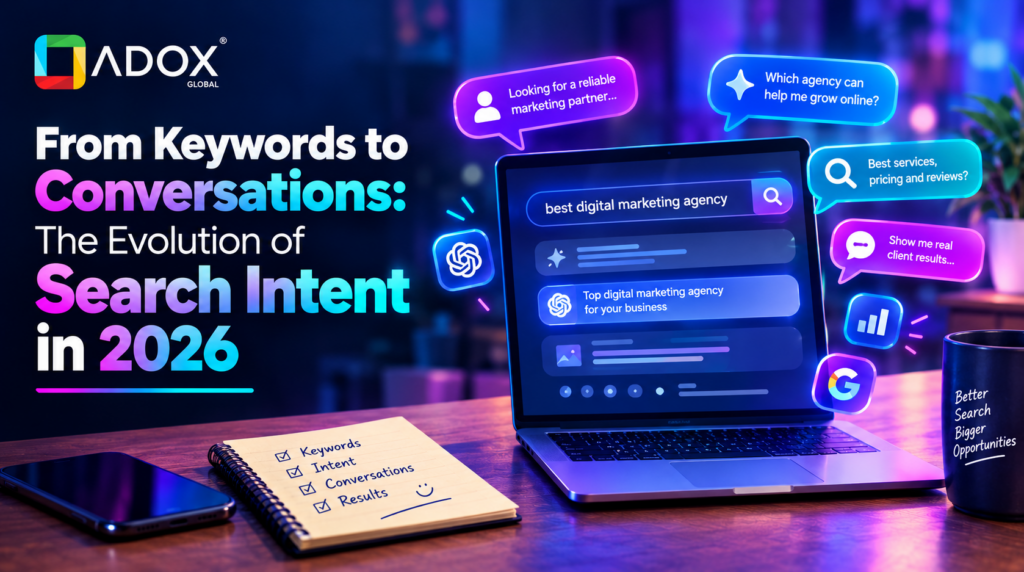
From Keywords to Conversations: The Evolution of Search Intent in 2026
A few years ago, ranking on Google was mostly a numbers game. Find the right keyword, use it enough times, build a few backlinks, and wait. We’ve built strategies that way ourselves. But if you’ve been watching your own website’s traffic lately, you’ve probably noticed something odd: you might be ranking well, and still getting fewer clicks than you expect.
That’s not a fluke. That’s search intent taking over from search keywords, and it’s changing faster than most businesses in Kochi have had time to catch up with.
We work with clients across industries, from local retail brands to service providers competing for attention in a crowded digital space, and this shift is one of the biggest things we talk about with almost every one of them right now. So we thought it was worth breaking down, in plain terms, what’s actually happening and what it means for anyone trying to grow online.
Why “Ranking for a Keyword” Doesn’t Mean What It Used To
Here’s the thing: Google isn’t just reading your page for matching words anymore. It’s trying to understand why someone typed what they typed.
Take a search like “digital marketing agency in Kochi.” On the surface, that looks like one simple query. But the person typing it could be a startup founder who needs everything handled end-to-end, or a marketing manager at an established company who just wants help with paid ads. Google’s AI systems are increasingly good at reading between the lines, picking up on context, past searches, and even the phrasing of the query, to guess which of those two people is more likely searching.
That means a page stuffed with the keyword but with nothing else going for it just doesn’t compete the way it used to. Depth, relevance, and clarity now carry more weight than repetition ever did.
We noticed this ourselves while working on client content over the past year. Blogs that answered a real question thoroughly, even without heavy keyword density, consistently outperformed pages that were technically “optimized” but shallow. It’s a pattern that’s hard to argue with once you see it in your own analytics.
The Four Ways People Actually Search
Most searches fall into one of four buckets, and knowing which one you’re writing for changes everything about how the content should be built.
- Informational, someone wants to learn something. Example: “how does SEO help a small business.”
- Navigational, someone’s trying to reach a specific brand or page. Example: “Adox Global services.”
- Transactional, someone’s ready to act. Example: “hire SEO agency in Kochi.”
- Commercial investigation, someone’s comparing before deciding. Example: “best SEO services in Kochi.”
A lot of businesses write one type of content and expect it to work for every kind of search. It won’t. A blog explaining what SEO is won’t convert someone who’s already comparing three agencies and just wants to see case studies. And a hard-sell landing page won’t rank for someone who’s still figuring out what they even need.
Why Google’s AI Rewards Intent-First Content
This isn’t just a theory. It’s showing up in how search results actually look now. AI Overviews, featured snippets, and “People Also Ask” boxes are pulling answers directly onto the results page, before a user ever clicks through to a website. A meaningful share of searches today end without a single click, because the answer is sitting right there.
That sounds worrying if you’re trying to drive traffic. But it also means the content that does get featured, the content Google trusts enough to surface directly, tends to be the content that answered the question clearly and completely. Getting picked for that visibility is arguably more valuable than a plain blue-link ranking used to be.
How We Approach This With Clients
We don’t believe in throwing out everything that’s already working. Most of the time, the smarter move is adapting what you have.
A few things we look at when reworking content for intent:
- Does the page answer the actual question in the first few lines, or does it make people scroll to find out?
- Are the headings written the way someone would actually ask a question, rather than as generic labels?
- Is there a natural next step, an FAQ, a comparison, a clear answer to “what happens next,” for someone who’s still deciding?
- Does the content sound like it was written by someone who understands the reader’s situation, not just someone trying to rank?
For a business searching for the best SEO services in Kochi, this is exactly the kind of thinking we bring to the table, not just optimizing for algorithms, but building content around what the person on the other end genuinely wants to know.
Do You Need to Rewrite Everything?
Not at all. In our experience, a full rebuild is rarely necessary. What usually works better is going back through your existing pages and asking whether they lead with a direct answer, whether they’re broken into sections a reader can scan, and whether the language sounds like something a real person would say out loud, not something built to please a crawler.
We’ve taken old, keyword-heavy pages for clients and reworked them this way without touching the core topic, and seen real movement in both rankings and engagement. It’s less about starting over and more about meeting the reader where they actually are.
Where This Leaves Kochi Businesses
Search behaviour is shifting everywhere, but there’s a particular opportunity for local businesses right now. A lot of companies searching for an SEO agency in Kochi are still being served generic, keyword-stuffed content by agencies that haven’t updated their approach. That’s a gap. Businesses that get ahead of this, that build content around genuine intent instead of just keyword density, are going to be the ones showing up when it counts.
That’s the work we do at Adox Global. If you’re trying to figure out where your own content stands in all this, we’re always happy to talk it through.