


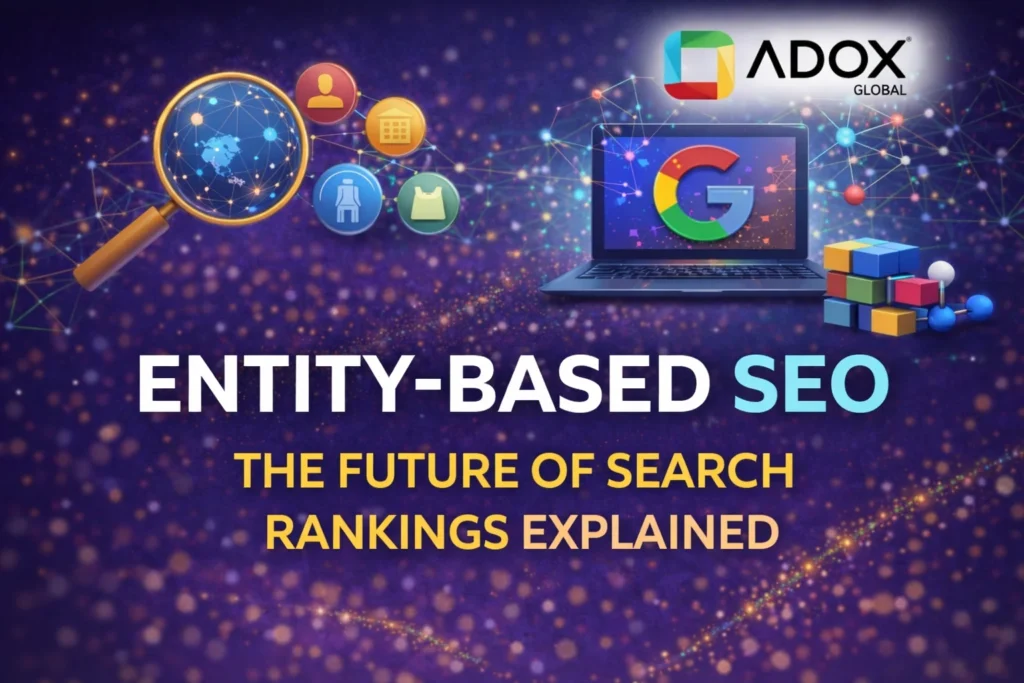
Entity-Based SEO: The Future of Search Rankings Explained
Search is no longer just about matching words. It has moved from “strings to things,” and that shift is at the heart of Entity-Based SEO. If you are planning your SEO strategy for 2026, this is something you simply cannot ignore.
At Adox Global, we have seen how Google continues to evolve through constant Google Search algorithm updates. Earlier, ranking was often about repeating keywords and trying to gain visibility. Today, search engines focus on understanding meaning, context, and relationships.
This matters now more than ever. In 2026, rankings depend on whether your brand is recognised as a trusted entity. It is not just about what you say, but who you are online and how clearly search engines understand your identity.
What is Entity-Based SEO and How it Works
To understand what is entity-based SEO and how it works, you need to start with the idea of an entity.
An entity is anything unique and clearly defined. It could be a person, a place, a business, or even an idea. For example, Apple Inc. is very different from an apple as a fruit. Even though the word is the same, search engines can distinguish them based on context.
This is where Semantic SEO becomes important. Instead of focusing only on keywords, it focuses on meaning. Search engines use technologies like natural language processing and machine learning to understand what users really mean when they search.
When someone searches for something like “Apple latest product,” Google understands the intent and connects it to the company, its products, and related information. This allows it to deliver more accurate results.
For businesses, this means your content should clearly define who you are, what you do, and how you are connected to your industry.
The Role of Google’s Knowledge Graph
A key part of entity-based SEO is the Google Knowledge Graph.
This system acts like a massive database that stores information about entities and the relationships between them. It connects billions of data points and helps Google understand how different entities relate to each other.
When you search for a known brand or personality, you often see a panel with quick information. This comes from the Knowledge Graph. It pulls data from trusted sources and presents it in a simple format.
For businesses, being connected to this system builds trust. It signals that your brand is real, recognised, and relevant. This is why Google Knowledge Graph SEO is becoming more important for long-term visibility.
Building Topical Authority with Content
If you want to use entity SEO for better rankings, you need to focus on building topical authority.
Instead of creating many disconnected pages, the goal is to build strong, in-depth content around a central topic. You start with a main page that covers a broad subject. Then you create supporting content that answers specific questions related to that topic.
All these pages should be connected through internal links. This helps search engines understand your expertise and see your website as a reliable source.
Search intent also plays an important role here. Keywords help you understand what users are searching for, but entities help you provide the right answers. When your content aligns with both, it becomes more valuable and ranks better over time.
Local SEO and Entity Strategies for Kochi Businesses
For businesses in Kochi, entity-based SEO strategies can bring strong local visibility.
Schema markup helps search engines understand your business details like services, location, and contact information.
Internal linking strengthens your website structure and shows how your content is connected. This improves both user experience and search visibility.
Local signals are equally important. Your business should be listed in trusted directories and connected to relevant local categories. A well-optimised Google Business Profile helps build credibility and improves your chances of appearing in local search results.
At Adox Global, we focus on building strong local entity signals that help businesses stand out. This is why we are known as the best SEO agency in Kochi for delivering effective and future-ready SEO strategies.
Future of SEO: AI and the 2026 Landscape
The future of search is closely connected to artificial intelligence. Tools like ChatGPT and Gemini rely on entity-based understanding to deliver accurate results.
These systems do not depend only on keywords. They use entity relationships and trusted data sources to generate meaningful answers.
If your business is not clearly defined as an entity, it becomes harder for these systems to recognise and recommend you. This is why entity-based SEO is a key part of any SEO strategy in 2026.
You cannot optimise for AI without first building a strong presence in search. Businesses that focus on clarity, consistency, and strong content will continue to grow.
Conclusion
Search is no longer about just ranking for words. It is about being understood.
Entity-Based SEO helps search engines see your business as a real and trusted presence. It focuses on meaning, relationships, and authority, which are essential for long-term success.
At Adox Global, we help businesses adapt to this new approach with strategies designed for the future. If you want to stay ahead and grow online, working with the best SEO agency in Kochi can make a real difference.
FAQs
- What is the difference between a keyword and an entity?
A keyword is the term people type into a search engine. An entity is the actual concept behind that term, along with its relationships to other concepts. - Do I need Schema markup for Entity SEO?
It is not compulsory, but it is highly recommended because it helps search engines understand your business more clearly. - How does Entity SEO help with AI-generated answers?
AI tools use entity data to understand context and select trusted sources. Strong entity signals improve your chances of being featured. - Why is topical authority better than keyword ranking?
Topical authority builds trust over time. It helps your website rank for a wider range of related searches without depending on exact keywords.