



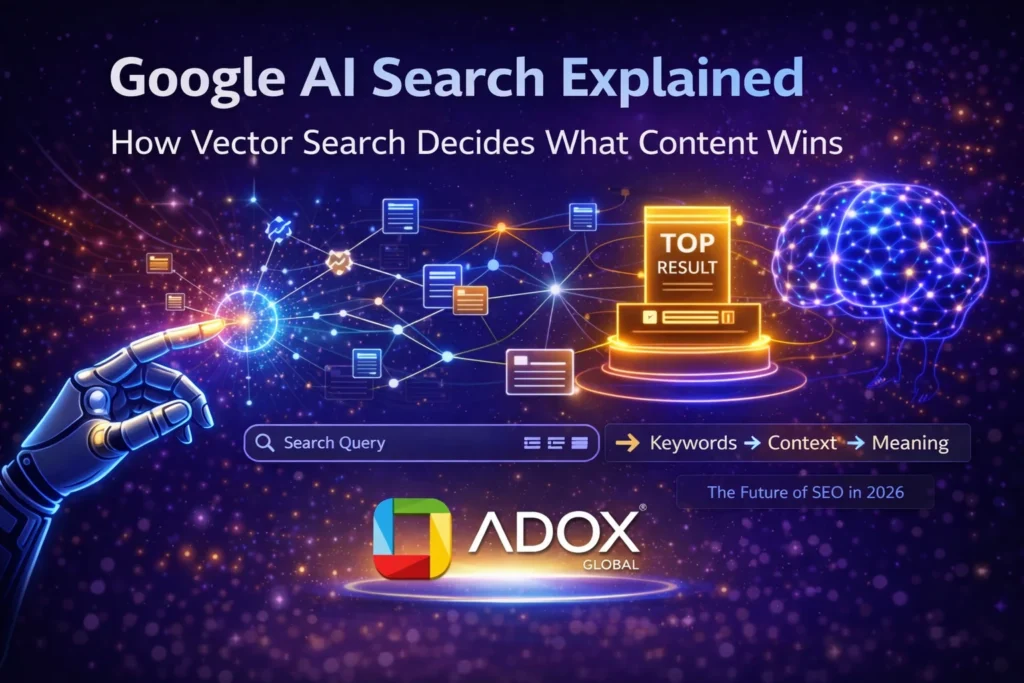
Google AI Search Explained: How Vector Search Decides What Content Wins
Search has changed in a big way. Today, it is no longer about what users type, but what they actually mean. This shift is the reason Google AI Search is reshaping how content is discovered and ranked.
At Adox Global, we have seen how this evolution is impacting brands. Earlier, ranking was heavily dependent on keywords. Now, content that focuses on meaning, intent, and depth is performing far better. The rules of SEO are not gone, but they have been redefined.
Traditional keyword matching is being replaced by smarter systems that understand context and relationships between ideas. This is where vector search in SEO comes into the picture. It allows search engines to interpret content in a much deeper way.
Understanding the Core: How Google AI Search Works
To understand modern SEO, we need to start with the basics. At the center of Google AI search is something called a vector.
A vector is a numerical representation of content. Instead of reading words like humans, search engines convert text, images, and videos into numbers that represent meaning. This allows machines to understand how different ideas are connected.
When content is created, Google uses advanced AI models such as BERT and MUM to convert it into embeddings. These embeddings are sets of numbers that capture meaning, tone, and context. This process forms the foundation of vector search seo.
Once the embeddings are created, they are placed in a large semantic space. In this space, similar ideas are grouped. For example, phrases like cheap flights and affordable airfare are treated as closely related, even though the wording is different.
When a user enters a search query, Google converts that query into a vector as well. It then compares this query vector with millions of content vectors to find the closest match. This method, known as nearest neighbor search, helps identify the most relevant results.
This is how Google AI search ranking works today. It is based on how closely the meaning of your content aligns with the meaning of the search query.
The Ranking Secret: How Vector Search Decides What Wins
The biggest shift in SEO is the move from keywords to intent. With vector search in SEO, content does not need exact keyword matches to rank well. Instead, it needs to align with what the user is really looking for.
For example, a user searching for natural ways to improve hair health may see content that explains routines, oils, and treatments, even if the exact phrase is not used. This happens because the content matches the intent behind the query.
Another important factor is semantic depth. In the past, repeating keywords was enough to rank. Today, search engines reward content that naturally includes related terms and explores topics in detail. Simply repeating phrases like Google AI search or vector search seo without meaningful information will not deliver results.
Context also plays a major role. Google understands the tone of content, the industry it belongs to, and even conversational language. This means your content should feel natural and useful, not forced or overly optimized. Understanding how Google AI search works requires understanding how users think and search.
Strategic Implications: Vector Search SEO and Topical Authority
As search evolves, content strategy must evolve as well. One of the most important factors today is topical authority. You cannot rely on a single page to rank consistently anymore.
To succeed in vector search seo, you need to build authority around a topic. This means creating multiple pieces of content that cover different aspects of the same subject. When your content is connected and comprehensive, search engines recognize your site as a reliable source.
Depth is equally important. Thin content does not perform well because it does not provide enough context. Strong content answers questions, explains concepts clearly, and explores related ideas. The more complete your content is, the better it aligns with a wider range of search queries.
Another key development is multimodal search. Google AI search now understands not just text, but also images and videos. All types of content exist in the same semantic space, which means visuals can also contribute to rankings. This creates new opportunities for brands to engage users and improve visibility.
Why Traditional SEO Is Not Enough
Traditional SEO still has value, but it is no longer enough on its own. Keywords continue to play a role, especially for specific searches like product names or branded terms. However, relying only on keywords limits your ability to rank for broader and more conversational queries.
Keyword-based search focuses on exact matches, while vector search focuses on meaning and intent. This makes vector search more flexible and effective in understanding variations in language.
The most effective approach today is a combination of both. This is often called a hybrid search strategy. It combines the precision of keyword matching with the intelligence of vector search. Keywords help capture direct queries, while vector search ensures your content aligns with deeper intent.
By balancing both approaches, you can improve visibility across a wider range of searches and strengthen your overall SEO performance.
Conclusion: Preparing for the Future of Search
Search engines are no longer just indexing content. They are understanding it in a much deeper way. Google AI search has transformed how information is processed, making meaning and context more important than ever.
To improve your Google AI search ranking, you need to focus on creating content that truly helps users. This means understanding their intent, providing valuable insights, and covering topics in depth.
At Adox Global, we help brands adapt to this shift by building content strategies that align with how modern search works. We focus on creating meaningful, high-quality content that connects with users and performs well in search.
The future of SEO is about understanding people. Brands that make this shift early will have a strong advantage in the evolving digital landscape.
Master the Future of Search with Adox Global
Navigating the world of vector search in SEO can feel complex, but the right strategy makes it manageable. At Adox Global, we combine AI-driven insights with practical content strategies to help brands grow and succeed.
FAQs
What is Google AI Search, and how is it different from traditional search?
Google AI Search focuses on understanding the intent behind a query instead of matching exact keywords. It delivers results that are more relevant and context-driven.
Vector search in SEO converts content into numerical representations based on meaning. This allows search engines to match queries with content based on relevance instead of exact wording.
How does Google use vector search to rank content?
Google converts both queries and content into vectors and compares them in a semantic space. Content ranks higher when it closely aligns with user intent.
Why is keyword optimization alone not enough?
Keyword optimization alone is not enough because modern search engines prioritize context, depth, and meaning. Content that fully explains a topic performs better.
How can I optimize my content for Google AI Search?
Focus on user intent, create detailed content, use natural language, and structure your content clearly so it is easy to understand.
Does vector search affect SEO rankings in 2026?
Yes, vector search seo plays a major role in rankings. It directly impacts how content is understood and matched with user queries, making quality and relevance more important than ever.