


SEO vs AEO vs GEO vs AIO: Which Search Strategy Will Win in 2026?
Search doesn’t happen in one place anymore. A customer might begin on Google, read the AI Overview at the top, ask ChatGPT a follow-up question and then turn to Perplexity to compare options. By the time they reach a website, they’ve often made up their mind. That makes it harder, and more important, for businesses to show up at every step.
That’s why the SEO vs AEO vs GEO vs AIO debate has become so common in marketing circles. The terms sound similar, and they do overlap, but each one serves a different purpose. Let’s look at what they mean and how we use them together.
What SEO, AEO, GEO and AIO Really Mean
SEO (Search Engine Optimization)
This is the one most businesses already know. SEO is about helping your website rank higher on Google, using the right keywords, earning good backlinks, keeping pages fast and fixing technical issues. The goal is to get someone to click through to your site.
AEO (Answer Engine Optimization)
With Answer Engine Optimization, the goal shifts from earning a spot on the results page to being the reply people read first. It’s what puts you in a featured snippet, a “People Also Ask” box, or the reply a voice assistant reads out loud.
GEO (Generative Engine Optimization)
Of all four approaches, Generative Engine Optimization is the most recent, shaped by the rise of AI-written answers. It focuses on getting your brand mentioned or cited when AI tools like ChatGPT, Perplexity, Gemini or Google’s AI Overviews put together an answer.
AIO (AI Optimization)
AIO works in the background. It helps AI systems understand your brand clearly: what you do, who you serve and why you’re trustworthy. Think of it as the groundwork that makes the other three more effective.
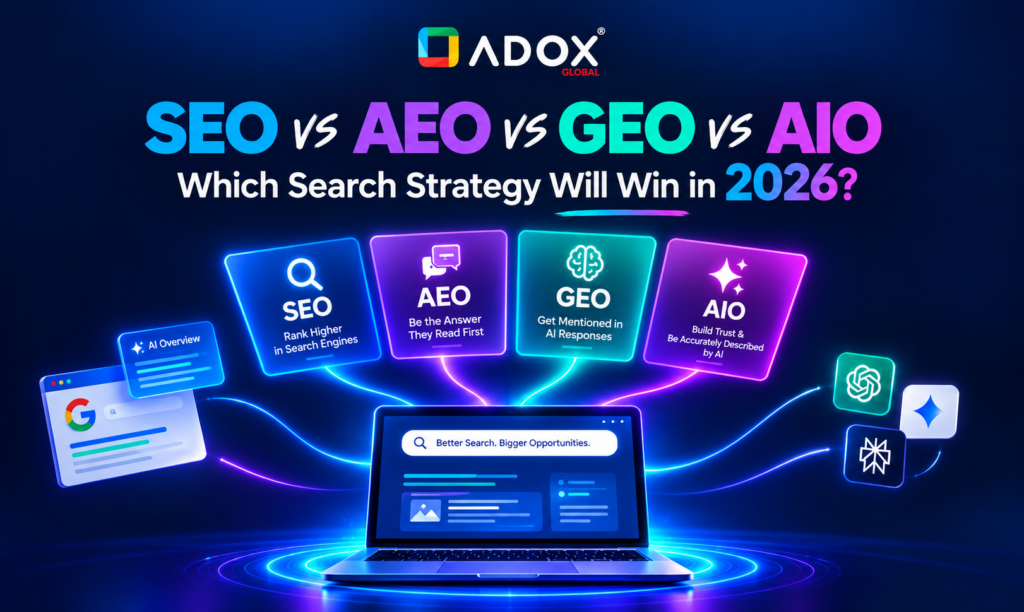
One way to keep them straight: SEO helps you rank, AEO helps you become the answer, GEO gets your name into AI responses, and AIO makes sure AI describes you correctly.
How Google and AI Tools Find Your Content
Google’s approach is fairly familiar. It crawls your pages, adds them to its index and decides where they should appear for each search.
AI platforms work a little differently. Some rely mostly on what they learned during training. Others, such as Perplexity, ChatGPT search and AI Overviews, search the web the moment a question is asked. They don’t read your page from top to bottom the way a visitor would. They pick out the passages that answer the question best and combine them with information from other sources.
That’s where AI search optimization creates an opening. You don’t have to be number one on Google to be quoted by an AI tool. Being the clearest answer often matters more.
Benefits and Limitations for Businesses in 2026
| Strategy | What You Gain | What to Watch Out For |
| SEO | Steady traffic that builds over time | Fewer clicks as AI answers appear above results |
| AEO | Top spot in snippets and voice search | People may get the answer without visiting your site |
| GEO | Visibility where buyers now start their research | Harder to track and less predictable |
| AIO | Long-term trust and accurate brand info in AI | Slow, indirect results[1] |
As the table shows, every strategy has a trade-off, and each one helps fill gaps the others leave.
The Techniques That Actually Work
Keywords Based on Real Questions
Short keywords still matter, but people now search in full sentences, especially when they’re talking to AI. We write around the questions customers actually ask and group related topics together. That way, both search engines and AI tools can see a subject has been covered properly.
Structured Data
Schema markup works like a set of labels for your website. It tells machines which part is your business name, which is a product and which is an article or FAQ. It won’t guarantee rich results, but it helps Google and AI platforms read your pages accurately.
Genuinely Helpful Content
There’s no shortcut here. Answer the question early, then explain it properly. Real examples, first-hand experience and a named author make content more believable, and that credibility is exactly what Google and AI tools are looking for.
Impact Across Google, AI Overviews, ChatGPT and Perplexity
| Platform | What It Rewards | Best Approach |
| Google rankings | Relevance, backlinks, good user experience | SEO |
| AI Overviews | Clear answers on pages that already rank | SEO + AEO |
| ChatGPT | Strong brand reputation across trusted sites | GEO + AIO |
| Perplexity | Fresh, well-sourced, easy-to-quote content | GEO + AEO[2] |
SEO appears in almost every row, and for good reason. AI Overviews mostly draw on pages Google already trusts, so strong rankings and AI visibility usually go together.
Our Practical Plan for Combining All Four
The most effective SEO strategies 2026 has to offer don’t pick one approach over the others. Here’s how we bring all four together for our clients:
- Build a strong base. We review site speed, mobile experience, crawlability and schema, and make sure your business details match everywhere they appear online.
- Listen to your customers. Enquiries, sales calls and reviews are full of useful questions. We turn the important ones into pages or sections that answer them within the first couple of lines.
- Write content AI can quote. Short paragraphs, clear headings and specific facts are far easier for AI tools to pick up than long, vague text.
- Get noticed beyond your website. Mentions on industry sites, directories, guest articles and honest reviews tell AI platforms that others trust you too.
- Keep key pages fresh. We revisit important content every few months so it stays accurate.
- Track what matters. We measure traditional search results and AI visibility side by side.
The numbers we watch:
● Organic traffic, keyword rankings and leads
● Featured snippets and “People Also Ask” spots
● Visits from ChatGPT, Perplexity and Gemini
● How often your brand appears in AI answers for your main services
● Growth in people searching your brand by name
So, Which One Wins?
None of them wins alone. Businesses that grow in 2026 will treat SEO, AEO, GEO and AIO as one connected effort rather than choosing a single favourite. That’s how we build search strategies at Adox Global. If you’re curious how your brand appears on Google and in AI search today, we’d be glad to take a look with you.
FAQs
1. Is SEO still relevant in 2026?
Yes. Most AI tools draw on content that already ranks well, so SEO remains the foundation for everything else.
2. What’s the difference between Answer Engine Optimization and Generative Engine Optimization?
Answer Engine Optimization is about being the single direct answer in a snippet or voice result. Generative Engine Optimization is about getting your brand mentioned within a longer, AI-written response.
3. How can I tell if ChatGPT or Perplexity mentions my business?
Check your analytics for visits from those platforms, and ask them questions about your services to see whether your brand comes up.
4. Does structured data help with AI search optimization?
It does. Schema gives AI tools clear information about your business, which helps them describe you accurately.
5. How long does GEO take to show results?
Usually a few months. Earning the trust and mentions that AI platforms rely on takes steady work, much like traditional SEO.