



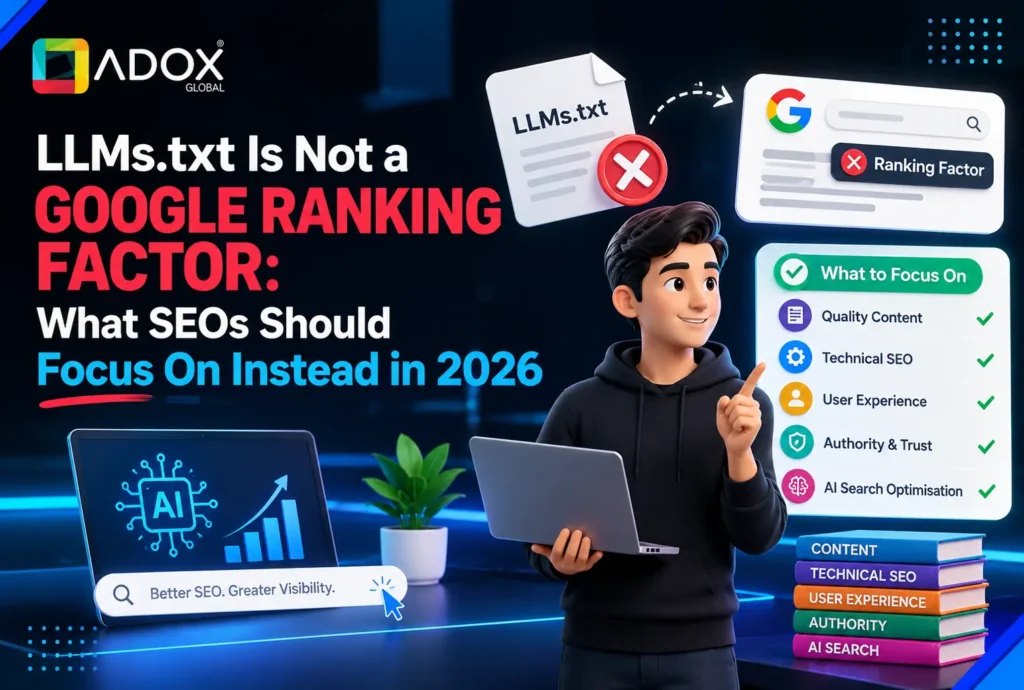
LLMs.txt Is Not a Google Ranking Factor: What SEOs Should Focus On Instead in 2026
When llms.txt files were spotted on several of Google’s developer subdomains, the SEO industry drew the obvious conclusion. Agencies began offering “AI-ready” audits, audit tools started flagging the missing file as an issue, and businesses were told that a single text file affected whether they would be cited in ChatGPT, Perplexity, and Google’s AI Overviews.
We reviewed the evidence before advising any of our clients to act on it. This is what we found.
Google’s position
Google’s John Mueller has addressed LLMs.txt directly on several occasions. Asked whether the presence of the file on a Google-owned property constituted an endorsement, his answer was no. The files appeared because the CMS behind Google’s developer documentation added support for them, and the feature was left enabled.
Mueller has also compared LLMs.txt to the keywords meta tag. That comparison is instructive. The keywords tag lost its value because it was a self-reported claim. Once every site made the same claim, the signal carried no useful information.
LLMs.txt has the same limitation. If a language model is selecting between two sources and both have published favourable self-descriptions, it still requires an independent basis for choosing. Google has since confirmed that Search does not use LLMs.txt to determine visibility, including within its generative features.
The file will not improve your rankings. It will also not harm them.
What the data shows
Three independent studies support the same conclusion.
SE Ranking analysed approximately 300,000 domains and found no relationship between the presence of an LLMs.txt file and how frequently a domain is cited in AI-generated answers.
Ahrefs examined server-log data across 137,000 domains and found that 97% of LLMs.txt files received zero requests in a single month. Among the files that were fetched, SEO audit tools accounted for the largest share of requests at around 21%. AI retrieval bots, which fetch pages to answer live user queries, accounted for approximately 1.1%.
Otterly.ai monitored AI bot traffic on a test domain over 90 days. Of 62,100 AI bot visits recorded, 84 targeted the LLMs.txt file, or 0.1% of total AI crawler traffic. The file was subsequently removed from their GEO audit checklist.
LLMs.txt is not an access control
A common misconception is that LLMs.txt functions as a robots.txt equivalent for AI systems. It does not. The file has no blocking capability and cannot prevent any crawler from accessing or using your content. Robots.txt, noindex directives, authentication, and paywalls remain the only effective controls.
Where the format is genuinely useful
The underlying concept has merit in a specific context. Clean Markdown reduces token consumption by roughly 20–30% compared with equivalent HTML and improves extraction accuracy. This is why documentation-led companies such as Stripe, Vercel, and Anthropic maintain these files: the audience is AI coding assistants retrieving developer documentation in real time, not search engines.
For developer platforms and API products, publishing one is a low-cost addition. For most commercial websites, it offers no measurable return.
What to prioritise instead
AI search operates through a retrieval pipeline. It extracts passages, synthesises answers from multiple sources, and determines which sources to cite. Four areas determine whether your content is selected.
Semantic depth over keyword targeting. Interconnected content covering a subject comprehensively performs better than isolated pages targeting individual phrases, because topical depth is measurable and difficult to fabricate.
Extractable page structure. Direct answers positioned early, defined terms, step-by-step formats, and genuine Q&A sections reduce ambiguity for retrieval systems.
Demonstrable expertise. Named authors, original data, verifiable client outcomes, and current publication dates support the trust signals AI systems rely on when attributing information.
Technical and schema foundations. Resolved crawl errors, LCP under 2.5 seconds, CLS below 0.1, and valid structured data determine whether your content can be read reliably in the first place.
Frequently asked questions
Is LLMs.txt a Google ranking factor?
No. Google has confirmed that Search does not use LLMs.txt for rankings, crawling, or its AI features.
- Should I remove an existing LLMs.txt file?
It is not necessary. However, it should not be treated as an AI visibility strategy, and you should confirm it is not generating duplicate Markdown versions of your pages.
- Does LLMs.txt prevent AI companies from using my content?
No. It has no enforcement capability. Use robots.txt, noindex, authentication, or a paywall.
- Do major AI providers use the file?
None have committed to using it in production systems. The clearest current use case is AI coding assistants retrieving developer documentation.
- What improves visibility in AI Overviews and ChatGPT answers?
Comprehensive topical coverage, extractable page structure, verifiable expertise, and sound technical SEO with valid schema markup.
Conclusion
In AI search, visibility depends less on being indexed and more on being understood. That outcome is produced by content architecture, expertise, and technical quality rather than by any single file.