



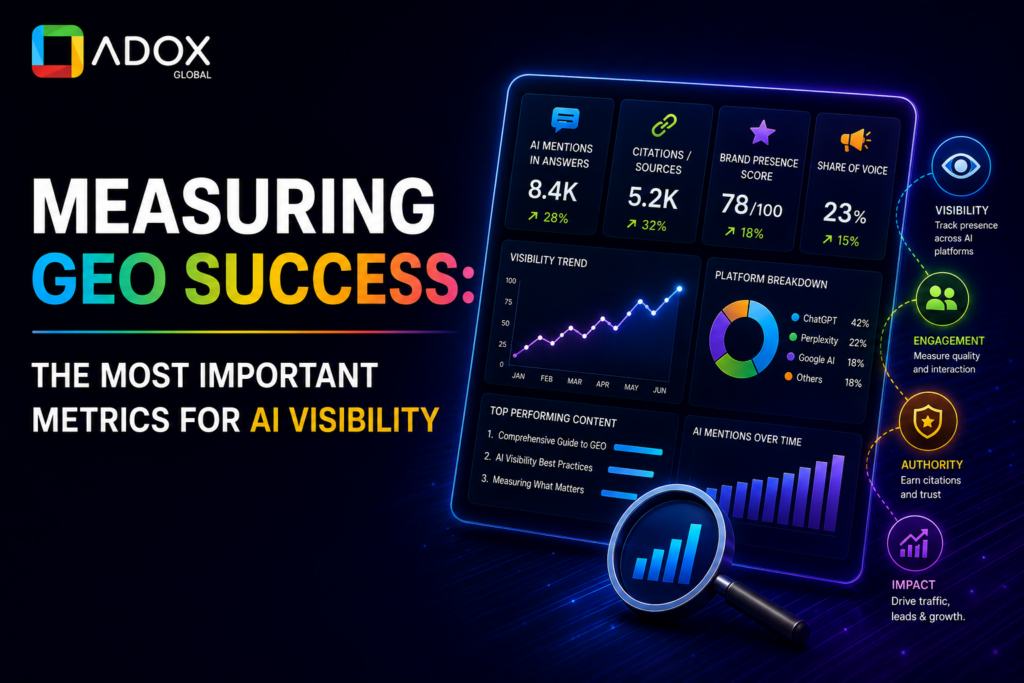
Measuring GEO Success: The Most Important Metrics for AI Visibility
A few months ago, “where do we rank on Google” was the only question that mattered. Now, every second client asks us a slightly different one: “does ChatGPT even know we exist?”
That’s the shift we’re navigating with our clients right now, and it’s a big one. Generative Engine Optimization (GEO) is about making sure AI platforms like ChatGPT, Perplexity, and Google AI Overviews actually mention your brand when someone asks a relevant question. But here’s the tricky part — how do you measure something that doesn’t come with a neat little ranking position?
We get this question a lot, so let’s break it down properly.
Why Your Old SEO Dashboard Won’t Cut It
Traditional SEO gives us clean numbers to work with — position on the page, click-through rate, organic sessions. Simple, trackable, comfortable.
AI search doesn’t play by the same rules. When someone asks an AI assistant a question, it reads through multiple sources, picks what it thinks is relevant, and hands the user a finished answer. Often, there’s no click involved at all. Your website could be the exact source the AI used, and you’d never see it in your Google Analytics.
So we need to stop asking “am I ranked number one” and start asking “am I mentioned at all, and if I am, how?” That’s really the heart of GEO measurement, and it comes down to three things: whether you’re mentioned, whether you’re cited as a source, and whether you show up in the right context.
The Metrics That Actually Matter
1. AI Brand Mentions and Citation Frequency
This is where we start. We put together a set of realistic questions people in your industry would actually type into an AI tool — think “which agency should I use for X in Kochi” or “is there a better alternative to Y.” Then we run these same questions across ChatGPT, Perplexity, Gemini, and Google AI Overviews, and track how often your brand shows up.
If you get mentioned in 15 out of 50 responses, that’s a 30% mention rate. It’s not perfect — AI answers vary between runs, even for the same prompt — so we track this over weeks, not one-off checks. A trend line tells you far more than a single snapshot.
2. AI Share of Voice and Query-Level Visibility
Showing up once isn’t the same as showing up well. We look closely at how your brand appears in each mention:
- Are you the first name suggested, or buried at the bottom of a list?
- Is the tone positive, neutral, or hesitant?
- Does the context match what you actually want to be known for?
- Is there a clickable link back to your site?
We score each of these, which gives us an AI Share of Voice — basically, how much space you’re taking up in AI answers compared to your competitors, for the exact same set of queries. This is where a digital marketing agency in Kochi like ours can really add value, because we’re constantly benchmarking against what your competitors are doing in the same AI conversations.
3. Content and Citation Quality
For an AI to trust your content enough to cite it, that content needs to be clear, well-structured, and genuinely useful — not stuffed with keywords for the sake of it. We track which of your pages actually get cited (FAQs, guides, and comparison pages tend to perform well here), and whether structured data like Schema markup is helping AI crawlers understand your site better.
One thing we always check: if your content only loads through JavaScript, a lot of AI crawlers simply won’t see it. It needs to exist in the raw HTML, not just render on screen for a human visitor.
4. Referral Traffic, Leads, and Conversions
At the end of the day, visibility only matters if it moves the needle for your business. We track a few indirect signals that tie GEO back to real outcomes:
- Is branded search volume — people searching your business name directly — going up?
- Are you seeing new referral traffic from platforms like Perplexity that do link out?
- Are direct visits with strong purchase intent increasing, which often happens when someone discovers you through an AI answer and comes back later on their own?
None of these give you a perfect, isolated number. But together, they paint a picture of whether your AI visibility is actually translating into business results.
Bringing It All Together
The most effective approach isn’t choosing between traditional SEO and GEO — it’s running both side by side. Your search rankings still matter. Your AI visibility is now sitting right alongside them, influencing how people discover and trust your brand before they’ve even clicked through to your website.
AI visibility is becoming a real part of how modern search marketing works, and it’s not going anywhere. Tracking your brand mentions and citations tells you whether generative platforms even recognize you. Your AI Share of Voice tells you how you stack up against competitors. And referral traffic, leads, and conversions tell you whether any of this is actually worth the effort. Keep an eye on all of it, keep refining your content, and treat this as an ongoing process rather than a one-time audit.
As AI-powered search continues to evolve, businesses need more than traditional rankings to stay visible. At Adox Global, we help businesses build integrated SEO, AEO, and GEO strategies designed to improve search presence, AI visibility, brand authority, and digital growth.
Ready to measure and improve your AI visibility? Contact Adox Global to build a data-driven GEO strategy for your business.
The Domination Continues.
FAQs
1. What is GEO in digital marketing?
Generative Engine Optimization (GEO) is the process of optimizing a brand’s content and online presence to improve its visibility in AI-generated search results and answers.
2. How do you measure GEO success?
GEO success can be measured through metrics such as AI brand mentions, citation frequency, AI share of voice, query-level visibility, referral traffic, brand representation, and AI-driven leads or conversions.
3. What is an AI citation?
An AI citation occurs when an AI-powered search or answer platform references a website or content source while generating a response. Tracking citations can help businesses understand which content is being recognized as a relevant or authoritative source.
4. Is GEO different from SEO?
Yes. SEO primarily focuses on improving visibility in traditional search engine results, while GEO focuses on increasing a brand’s visibility, mentions, and citations within AI-generated answers. However, both strategies complement each other and should be integrated.
5. What is AI Share of Voice?
AI Share of Voice measures how frequently a brand appears in AI-generated responses compared with its competitors for a defined set of relevant queries. It helps businesses understand their relative visibility within AI search experiences.
6. Can GEO generate leads and conversions?
Yes. Improved AI visibility can contribute to brand discovery, website visits, enquiries, and conversions. Businesses should track AI referral traffic and conversion data alongside visibility metrics to understand the actual business impact of GEO.