



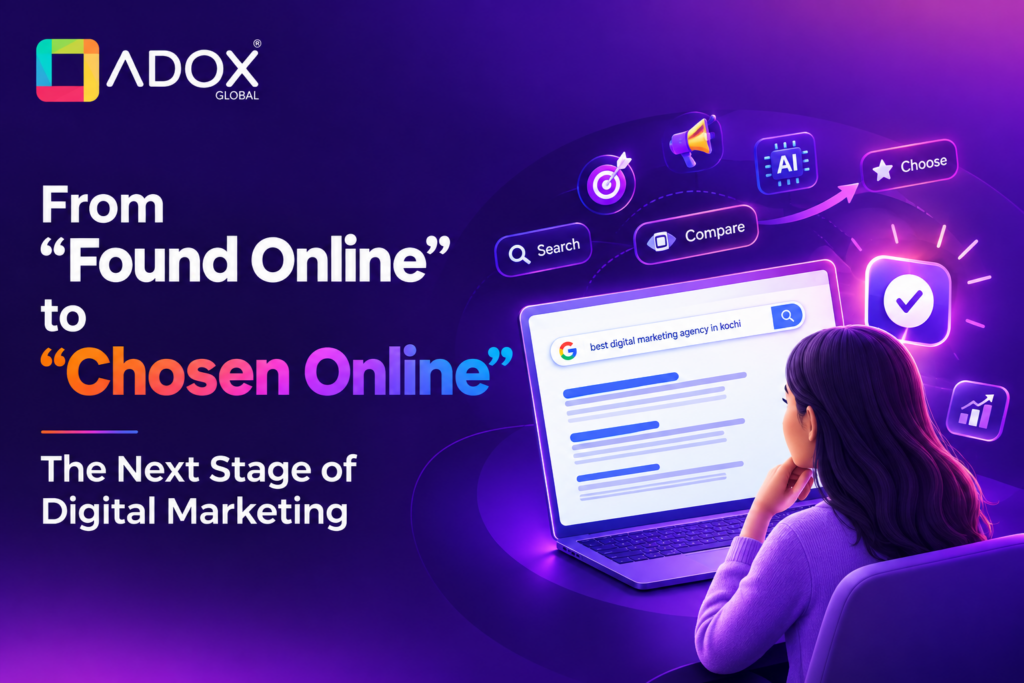
From “Found Online” to “Chosen Online”: The Next Stage of Digital Marketing
For almost two decades, digital marketing had one central goal: get found. Rank on Google, show up in the search results, win the click. Entire careers, budgets, and strategies were built around that single idea.
That goal hasn’t disappeared. But it’s no longer enough.
With the rise of AI search, recommendation engines, and zero-click experiences, being visible isn’t the same as being chosen. Today, a user might never scroll past an AI-generated answer. They might never click a single blue link. Instead, ChatGPT, Gemini, or Google’s AI Overviews decide — on the user’s behalf — which brand, product, or piece of content gets surfaced as the answer.
That’s the shift. Brands don’t just need to be discovered by users anymore. They need to be selected by algorithms and AI assistants.
What “Chosen Online” Actually Means
Being “chosen” means an AI system has decided your brand is the answer — not just an option buried in a list of ten links.
This looks like:
- ChatGPT or Claude naming your brand directly when someone asks for a recommendation
- An AI shopping assistant suggesting your product over a competitor’s
- Google’s AI Overview summarizing your content as the definitive source
- A voice assistant reading out your business as the top pick, with no alternatives shown
In each case, there’s no scrolling, no comparing, no second option on screen. You’re either the one selected, or you’re invisible.
Why This Shift Is Happening
This shift is happening because several changes are coming together at the same time::
- Generative AI has gone mainstream. Millions of people now ask ChatGPT questions they used to Google.
- Trust has shifted. Users are increasingly comfortable trusting a single AI-curated answer instead of clicking through and comparing five websites themselves.
- Behavior has changed. Fewer clicks, fewer tabs open, more direct answers expected on the first try.
None of this replaces search. It sits alongside it — and it’s growing fast.
The New Success Factors: How Brands Get “Chosen”
Ranking well on Google still matters. But getting chosen by AI systems depends on a slightly different set of signals:
- Structured, well-cited content that clearly demonstrates experience, expertise, authority, and trust (E-E-A-T)
- Brand mentions across the web — not just backlinks, but being referenced by name in articles, forums, reviews, and third-party sites
- Consistent, accurate data across platforms, supported by proper schema markup and knowledge panels
- Strong reputation signals, including reviews and independent validation
- Visibility built specifically for AI systems, often called Generative Engine Optimization or Answer Engine Optimization
From SEO to GEO/AEO: The Evolving Toolkit
Traditional SEO was built to help pages rank. Generative Engine Optimization (GEO) and Answer Engine Optimization (AEO) are built to help answers get selected.
That means content strategy has to adapt:
- Writing concise, direct answers instead of long buildups
- Structuring content around FAQs and clear headings
- Using structured data so AI systems can extract information accurately
- Prioritizing clarity over keyword density
SEO isn’t being replaced here — it’s being extended.
Building a “Chosen Online” Strategy: Practical Steps
For brands wondering where to start, a few practical moves make a real difference:
- Audit your current AI visibility. Type your own brand and product queries into ChatGPT, Gemini, and Perplexity. See what comes up — or doesn’t.
- Strengthen topical authority. Publish content that goes deep on your subject area, not just scattered one-off posts.
- Invest in digital PR and earned mentions. AI systems weigh how often and how credibly your brand is mentioned elsewhere.
- Fix the technical foundations. Schema markup, structured data, and clean site architecture all help AI systems read your content correctly.
- Monitor brand sentiment and citations. Keep track of how AI platforms are describing your brand, and correct inaccuracies early.
A Quick Example
Picture two travel agencies. Both rank on page one of Google for “best travel agency in Dubai.”
Agency A has solid SEO — good keywords, decent backlinks, fast site. But their content is generic, their reviews are scattered across platforms, and there’s no structured data on their site.
Agency B has similar SEO, but also publishes detailed guides, keeps consistent business information everywhere it’s listed, and has verified reviews with real detail.
Ask ChatGPT which one to book with, and Agency B is far more likely to get named. Same rankings. Very different outcomes.
Visibility Got You Found. Trust Gets You Chosen.
Being found on Google is still the starting point — it always will be. But in a world where AI assistants are increasingly making decisions on behalf of users, visibility alone won’t carry a brand forward.
The brands that win next aren’t just the ones ranking highest. They’re the ones AI trusts enough to recommend.
At Adox Global, we help businesses make that exact transition — auditing AI visibility, building authoritative content, strengthening structured data, and developing a GEO/AEO strategy designed to earn recommendations, not just rankings.
FAQs
- What is the difference between “chosen online” and “found online”?
“Found online” is the classic visibility model, whereby people find a website, whereas “chosen online” is the visibility when the website is actively recommended or chosen by AI tools, algorithms, and recommendation engines as the most optimal website for a user’s need.
- How does GEO differ from traditional SEO ?
While traditional SEO efforts target web page rankings in search engine results, GEO aims to enhance content that AI tools such as ChatGPT, Gemini, and AI Overviews cite, summarize, or recommend.
3. How does AI-powered search results affect brand marketing?
With a growing number of users preferring AI-generated responses over a series of clickable links, brands need to make sure their content is accurate, well-organized and authoritative enough to be chosen as the AI’s source of information.
4. How does an organization know whether it’s being “chosen” by AI tools?
Businesses can conduct a test on a specific query and check if it is mentioned or recommended in the AI’s responses, such as in ChatGPT, Perplexity, or Google AI Overviews.
5. How does structured data help become visible for AI?
Structured data (schema markup) can assist AI systems in understanding and accurately pulling information about a business to help ensure it gets cited correctly in AI-generated answers.
6. How can Adox help my brand transition into this new stage of digital marketing?
Adox helps businesses audit their current AI and search visibility, build authoritative content, implement structured data, and develop a GEO/AEO strategy designed to earn recommendations from AI-driven platforms — not just search rankings.