



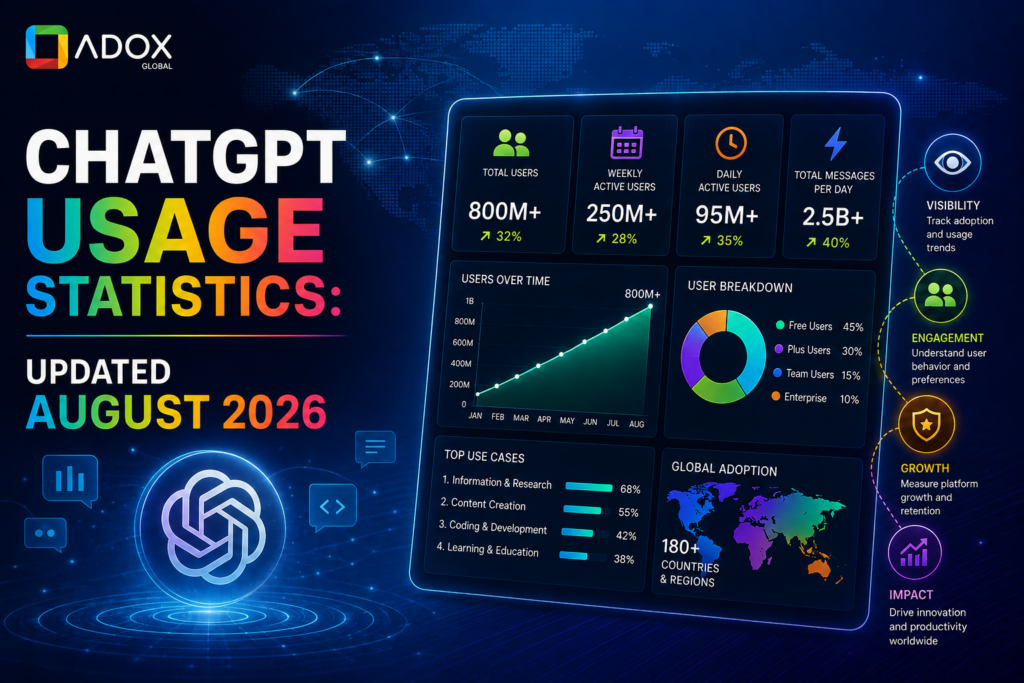
ChatGPT Usage Statistics: Updated August 2026
Every second the client calls, someone asks about ChatGPT. Is it still growing? Are people actually searching for it now? Should we be worried about traffic dropping? So instead of answering the same questions over and over, we figured we’d just put all the numbers in one place.
ChatGPT user growth and latest statistics in August 2026
Here’s the big one first. ChatGPT crossed 1 billion monthly active users in June 2026, and depending on which report you’re reading, weekly active users are somewhere between 900 million and 1 billion. That’s more than double where things stood in early 2025.
And it’s not slowing down. It’s the fastest app in history to hit a billion users, full stop. Over 5 billion visits a month, 2 to 2.5 billion prompts sent every single day. Numbers that big are hard even to picture.
But here’s the twist nobody talks about enough: ChatGPT’s total users keep climbing, yet its share of the AI chatbot market is actually shrinking. Sensor Tower found it dropped below 50% of the market for the first time in May 2026. So the pie’s getting bigger faster than ChatGPT’s slice of it, thanks to Gemini, Claude, and Perplexity all chipping away. It’s still the clear leader. But it’s not the only game in town anymore, and that matters.
Money-wise, OpenAI’s pulling in between $10 and $ 13 billion a year, with over 50 million paying subscribers. Not bad for something that didn’t exist five years ago.
How people are using ChatGPT in 2026
Remember when ChatGPT felt like a novelty, something you played with once and forgot about? That phase is long over. People use it for research first, then academic work, coding, and writing emails. But honestly, it’s creeped into the small stuff too — planning meals, drafting a message you don’t know how to phrase, figuring something out instead of opening ten browser tabs.
What we find genuinely interesting is who’s using it now. It used to be the tech crowd. Now adoption is growing fastest among people over 35, and it’s roughly split between men and women. It’s become as ordinary as checking Google or opening WhatsApp.
The US still sends the most traffic, but India’s caught up fast and is now the second-biggest market, past 100 million weekly users and growing over 40% year on year. Brazil, Indonesia and a good chunk of Southeast Asia aren’t far behind. So if you’re building content for a global audience, the growth story isn’t in North America anymore. It’s everywhere else.
ChatGPT adoption among businesses and professionals
This is the part we actually care about as marketers. Business adoption hasn’t just grown; it’s taken off. Over a million businesses are now paying customers, and more than 9 million people use it for work every week, a number that quadrupled in under six months.
Even the big companies are on board. Around 92-93% of Fortune 500 firms now use ChatGPT or some OpenAI product, up from 80% two years back. Enterprise seats are up nearly 9x year on year. And custom GPTs, the versions companies build for their own internal use, now make up close to a fifth of all enterprise messages.
The productivity side is worth mentioning to clients too. About 75% of enterprise workers say it’s made them faster or improved their output quality. People are saving anywhere from 40 minutes to over an hour a day, and for the heavy users, that’s more than 10 hours a week back in their pocket.
ChatGPT’s impact on search behaviour and AI search
If you do SEO or content, this is the section to actually sit with. Search is changing shape, and ChatGPT is a big reason why.
About 37% of people now start their search inside an AI tool instead of Google. For B2B buyers, it’s even higher: over half start their product research in a chatbot now, not a search engine.
Which brings us to zero-click search. When Google shows an AI Overview, only around 8% of people bother clicking through to a website, compared to 15% without one. Google’s AI Mode takes it further, with a zero-click rate as high as 93%. A lot of searches now end right there, with an answer, not a click.
That doesn’t mean SEO is dying. It just means the goalpost moved. The real win now isn’t the top ranking; it’s getting quoted inside the AI’s answer itself. People have started calling this GEO, Generative Engine Optimization, and it’s becoming its own discipline. Here’s the silver lining, though: the traffic that does come from ChatGPT converts far better than regular organic traffic. Less volume, better quality.
Major ChatGPT and generative AI trends in 2026
A few things stand out this year. Agentic AI, tools that don’t just chat but actually go do things for you, is picking up fast, with nearly a quarter of companies already using it somewhere in their operations. Voice and multimodal use is growing too, especially on mobile, where people are happy to just talk to their phone and get an answer without ever looking at a screen.
Competition is heating up as well. ChatGPT’s still on top, but Gemini and Claude have both found real footing, especially in enterprise settings. And zooming out, global AI spending is set to cross $2.5 trillion this year. This isn’t a trend anymore. It’s just infrastructure now.
What ChatGPT’s growth means for digital marketing and businesses
For us at Adox Global, and for the brands we work with, this changes how we think about strategy. Ranking on Google isn’t enough by itself anymore. Brands need to show up inside AI answers too, and that comes down to structured content, real topical authority, and being a source these tools trust enough to cite.
We’re also noticing that AI-driven traffic, even in smaller volumes, tends to bring in better leads. So the smarter play isn’t chasing clicks anymore. It’s about getting mentioned, getting referenced, and building the kind of trust that shows up whether a person is reading you or an AI model is.
If there’s one takeaway here, it’s this: ChatGPT isn’t a passing wave businesses can wait out. It’s becoming part of how people search, work and decide things day to day, and marketing strategy needs to catch up.
FAQs
1. How many people use ChatGPT as of August 2026?
It’s crossed 1 billion monthly active users, with weekly active users sitting somewhere between 900 million and 1 billion.
2. Is ChatGPT still growing faster than its competitors?
It’s still the leader by a wide margin, but its overall market share has actually dipped below 50% as Gemini, Claude and Perplexity gain ground.
3. How is ChatGPT affecting SEO and website traffic?
It’s driving more “zero-click” searches, where people get their answer without visiting a website. Showing up inside AI-generated answers now matters just as much as ranking well.
4. How many businesses use ChatGPT for work?
Over 1 million businesses pay for it, and more than 9 million people use it weekly for work. Fortune 500 adoption is now above 90%.