



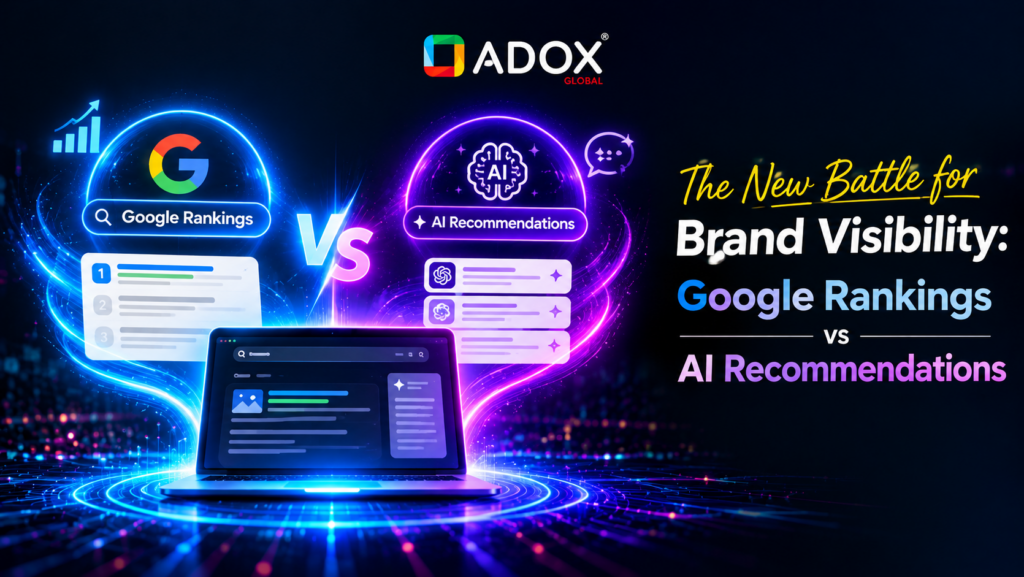
The New Battle for Brand Visibility: Google Rankings vs AI Recommendations
Quick question. When was the last time you asked ChatGPT for a recommendation?
Maybe it was a restaurant, a laptop, or a good dentist nearby. Whatever it was, you probably didn’t open ten tabs afterwards. You got a couple of names, picked one, and moved on.
Now flip it around. What happens when your customers do the same thing? Does your brand come up? Or does a competitor’s?
That’s what we want to talk about today, because it’s quietly changing how brand visibility works.
People Don’t Just Search Anymore. They Ask.
Let’s be honest, we’ve all changed how we look for things. We still use Google, of course. But now we also type full questions into ChatGPT or Gemini, the way we’d ask a friend.
“Which digital marketing agency in Kochi is good for a small clinic?”
And what do we get back? Not a page full of links. Just a short answer with two or three names.
So if you run a business, there’s a new question to think about. It’s not only “Where do we rank on Google?” It’s also “When someone asks, does our name even come up?”
Wait, So Is Google Not Important Anymore?
Oh, it is. Don’t let anyone tell you otherwise.
When people are ready to buy, book or call, a lot of them still head straight to Google. A good ranking keeps bringing customers to your door, day after day. And Google now shows AI Overviews right at the top of its results, so doing well there actually helps you twice.
Here’s something else worth knowing. AI tools don’t pull their answers out of thin air. They rely a lot on what’s already published on the web, which is often the same content Google ranks. So no, SEO isn’t dead. It’s more like the ground floor of the building.
Then How Does AI Decide Who to Recommend?
Good question, and this is where it gets interesting.
Google mostly looks at whether a page matches what someone searched for. AI is trying to figure out something slightly different: “Do I know enough about this brand to suggest it?”
So what helps? A few things.
First, clear content. If your page answers a question straight away, AI can use it. If it takes three paragraphs to get to the point, AI probably won’t bother.
Second, consistency. Is your business name, address and list of services the same on your website, your Google Business Profile and your social pages? If yes, great. If not, AI gets confused, just like a customer would.
Third, what others are saying about you. Reviews, mentions in articles, directory listings, even people talking about you on forums. All of this tells AI you’re the real deal.
And finally, actual expertise. If your content genuinely helps people, it gets noticed. If it’s just written to squeeze in keywords, it usually doesn’t.
“But We’re on Page One. Why Isn’t AI Mentioning Us?”
We hear some version of this a lot. And it’s a fair thing to wonder.
Think of it this way. Google ranks pages. AI recommends brands. You might have one page that’s doing brilliantly on Google. But if there’s hardly anything about your business anywhere else online, AI doesn’t feel confident vouching for you.
Now add a few old reviews, a different phone number on one listing and an outdated address on another. See the problem? When AI isn’t sure, it does what you’d do. It plays it safe and suggests someone else.
Okay, So What Can You Actually Do?
Here’s the nice part. You don’t need one plan for Google and a completely different one for AI. Most of the good stuff works for both.
Start by thinking about what your customers keep asking you. On calls, on WhatsApp, at the counter. Write about those things. And put the answer near the top, not buried at the bottom. A simple FAQ section and some structured data on your key pages will also make life easier for both Google and AI.
Next, do a little housekeeping. Search for your business online and check that your details match everywhere. Yes, it’s boring. But you’d be surprised how often this is the thing holding brands back.
Then, get people talking. Ask happy customers for reviews. Most of them are glad to help if you just ask nicely. Write a guest article, get listed in directories that matter in your field, and share what you’ve learned from your own work. Real experience is what people (and AI) love to quote.
Oh, and don’t forget your website itself. Is it fast? Does it work well on a phone? If the basics aren’t right, nothing else will save it.
This is pretty much how we approach SEO at Adox Global now. We still care about rankings, of course. But we put just as much effort into making sure a brand is easy to understand and easy to recommend.
So, Where’s All This Heading?
Honestly? It’s not going to be Google versus AI. People will use both, sometimes within the same hour.
That’s why SEO, AEO and GEO are slowly becoming one big strategy. SEO helps you rank. AEO (Answer Engine Optimisation) helps your content become the answer. GEO (Generative Engine Optimisation) helps your brand get named when AI suggests options.
The brands that start working on all three now will be miles ahead in a year or two. Curious how yours is doing? Just drop us a message. We’d love to take a look with you.
Frequently Asked Questions
1. What’s AI search optimisation, in simple words?
It’s making sure tools like ChatGPT, Gemini and Google’s AI Overviews know who you are, understand what you do, and feel comfortable recommending you.
2. Should we still invest in SEO?
Definitely. AI tools lean on trusted, well-ranked websites, so good SEO is still where everything begins.
3. AEO and GEO sound pretty similar. What’s the difference?
They are similar! AEO is about your content becoming the answer to someone’s question. GEO is about your brand being mentioned when AI lists options.
4. We rank well on Google. Why doesn’t AI talk about us?
Usually it’s one of three things: not enough said about you elsewhere online, details that don’t match across platforms, or content that doesn’t answer questions clearly.
5. How long before we see a difference?
It depends on where you’re starting from. But with regular content, steady reviews and a few technical fixes, most brands start noticing a change within a few months.