



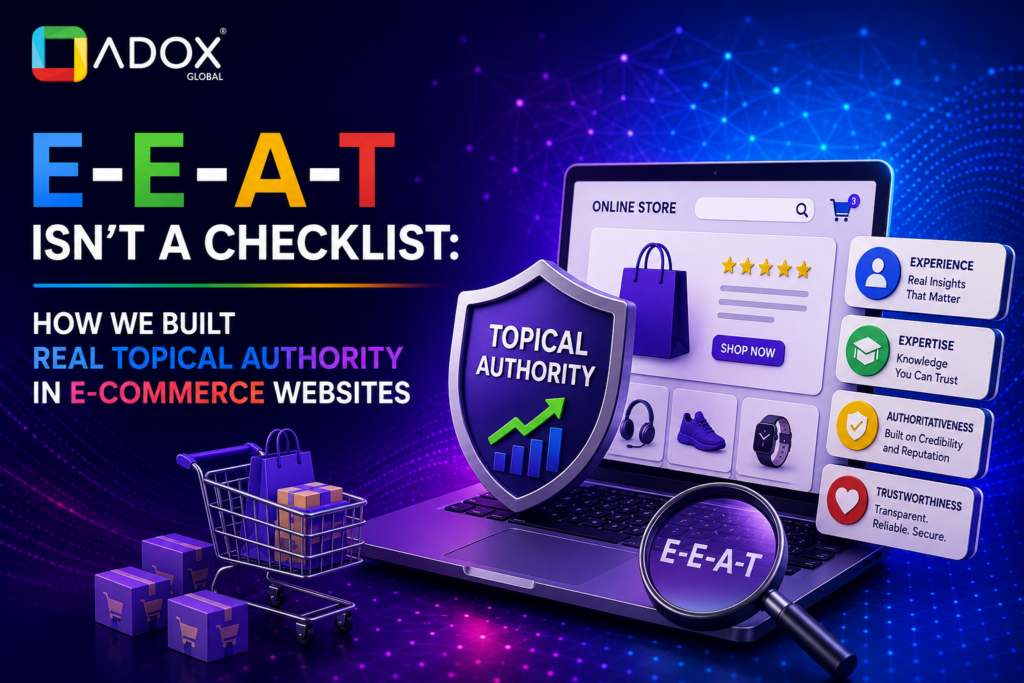
E-E-A-T Isn’t a Checklist: How We Built Real Topical Authority in E-Commerce Websites
Most teams treat E-E-A-T like a to-do list. Tick the author bio, add a few citations, slap on some reviews, and call it done. We used to think that way too — until our rankings flatlined despite doing everything “right.” What finally moved the needle wasn’t a checklist. It was building genuine topical authority, piece by piece.
Here’s what we learned running an e-commerce seo strategy that actually held up over time.
Authority is earned, not declared
Google doesn’t hand out trust because you added a “Reviewed by an expert” badge. It watches whether your site consistently covers a subject with depth. When we managed a mid-sized outdoor gear store, we stopped writing scattered product blurbs and started owning entire subjects — how to choose hiking boots, break them in, waterproof them, and repair them.
That cluster of related content told Google something a single page never could: these people know boots.
Experience is the “extra E” people ignore
The first E in E-E-A-T stands for Experience, and it’s where most stores fall short. Manufacturer descriptions won’t cut it. We had staff photograph products in real use, write about what actually wore out after six months, and answer the awkward questions competitors avoided. That firsthand signal is hard to fake and even harder for rivals to copy.
Good e-commerce content marketing isn’t about publishing more. It’s about publishing things only you could write.
Clusters beat one-off posts
Instead of chasing random keywords, we mapped every topic our customers cared about and grouped them. A central “pillar” page covered the broad subject, and supporting articles handled the specifics, all linked together.
This structure did two things. It helped shoppers find answers without leaving the site, and it showed search engines a clear web of expertise rather than isolated pages fighting for scraps.
Trust lives in the details
Trust isn’t one big gesture; it’s a hundred small ones. Clear return policies. Real customer reviews — including the critical ones. Author names attached to guides, with credentials that mean something. Fast, secure checkout. Accurate stock information.
We audited all of it, because a single broken promise undoes months of content work. A shopper who spots one outdated price rarely reads your beautifully written guide — they’ve already left. Trust is fragile and cumulative, so we treated every page as a chance to earn it or lose it.
Consistency is what compounds
None of this works as a one-time sprint. The stores that win keep showing up — refreshing old guides when facts change, answering new customer questions before rivals do, and pruning thin pages that dilute their focus. We set a simple rule: every published page should still deserve to rank a year later. That discipline is unglamorous, and it’s exactly why so few brands stick with it. But authority compounds like interest. The content we published in month one kept pulling traffic long after we’d moved on, quietly lifting everything connected to it. Slow, steady, and remarkably hard to dislodge.
What changed when we stopped treating it as a checklist
Within eight months, that outdoor store ranked for hundreds of long-tail queries it never targeted directly. Organic traffic roughly doubled, and — more importantly — it converted, because the people arriving already trusted the brand.
That’s the quiet advantage a thoughtful digital marketing company brings: not tricks, but the patience to build authority the way Google actually rewards it.
E-E-A-T isn’t something you complete. It’s something you become. And in e-commerce, where trust decides whether someone hands over a card number, becoming the obvious authority is the whole game.
FAQs
How does topical authority improve e-commerce SEO performance?
When your site covers a subject thoroughly, Google treats you as a reliable source and ranks more of your pages — including ones you never directly optimized. Topical authority also strengthens internal linking and keeps shoppers engaged longer, both of which quietly feed better rankings over time.
Is it possible to get good search engine rankings without topical authority?
Maybe for a bit — on brand or lower-traffic keywords. But sustained rankings on valuable, competitive keywords are tough without it. Stores that skip authority-building usually plateau, then slip behind competitors who cover the same subjects with far more depth.
How does content clustering help establish topical authority?
Clustering links a broad “pillar” page to focused supporting articles, creating a clear map of expertise. This helps search engines understand how your content connects, spreads ranking power across related pages, and gives visitors a natural path to explore without bouncing away.
What role does E-E-A-T play in Google’s ranking algorithm?
E-E-A-T (Experience, Expertise, Authoritativeness, Trust) isn’t a direct ranking factor, but it shapes the signals Google’s systems reward. It’s most important for pages relating to money or wellbeing — which is most of e-commerce — as credibility affects visibility.